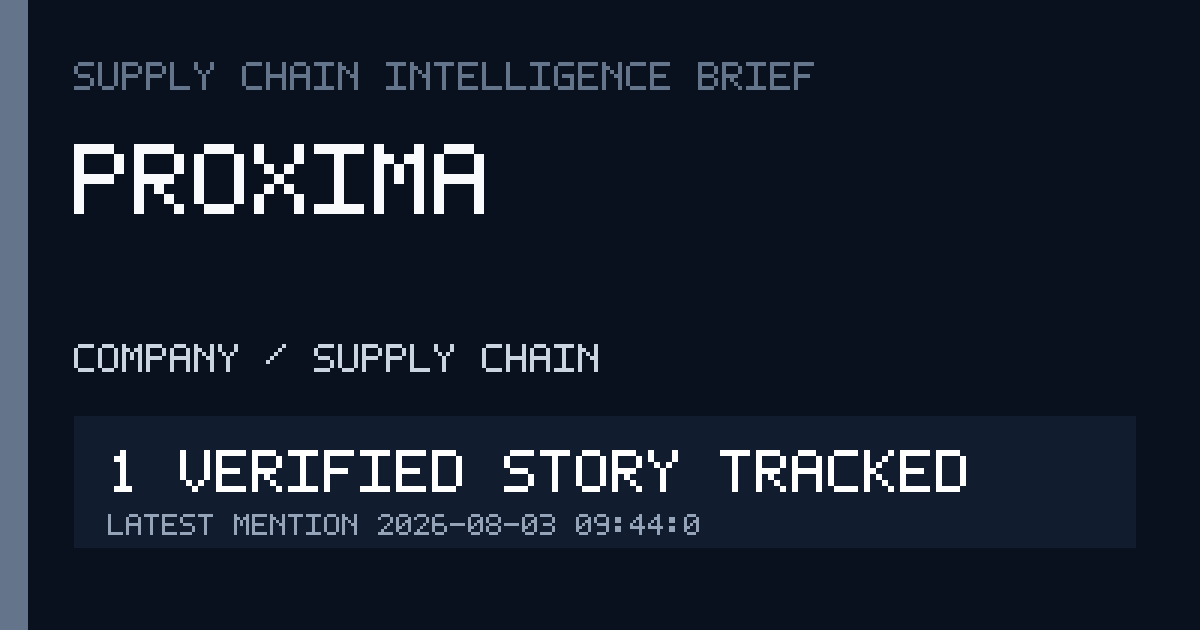
Across the most recent 1 story covering Proxima — 100% neutral sentiment, averaging 5/10 impact.
This entity profile aggregates every story where the entity meets our minimum relevance
threshold before it is linked here — a story naming this entity only in passing, as
competitive context for an unrelated subject, does not qualify. That threshold exists
because earlier testing surfaced entity pages cluttered with tangential mentions: a story
about two unrelated companies merging could otherwise populate a third company's page
simply because it was named once for comparison, with no real event of its own. The
timeline below reflects genuine milestones and developments specific to this entity,
cross-referenced against the same source-verification standard applied to every story on
this site. Sentiment measures the directional read of each development for this entity
specifically, not the overall tone of the reporting, and impact weights how consequential
a development is rather than how widely it was syndicated across outlets.
Figures are computed live from our source-verified story record — see our methodology for how impact and
sentiment are derived.
Timeline
New 10-12.5% forced-labour tariff regime announced
US Trade Department imposes tariffs of 10% to 12.5% on approximately 60 countries including the UK under forced-labour provisions. EU benefits from separately negotiated more favourable terms.
Temporary 10% levies expire
The interim tariff regime came to an end, creating a deadline for the US administration to introduce replacement measures.
US Supreme Court strikes down temporary tariffs
The US Supreme Court declared the existing temporary 10% levies illegal, forcing the administration to develop a new legal basis for tariff measures.
The new US forced-labour tariff regime imposes 10-12.5% duties on UK exports while the EU operates under a more favourable deal, creating a procurement cost gap that threatens to relegate British suppliers to second-tier status. Supply chain consultancy Proxima warns UK firms are underprepared for the compounding cost pressures. Procurement teams face immediate sourcing recalculations as US importers gain a structural incentive to switch from UK to EU suppliers.
This page surfaces every story mentioning Proxima across our supply chain coverage. We track each entity's appearance over time so readers can trace how the narrative evolves — which developments are isolated incidents, which build into longer arcs, and which reframe how operators in the space think about the entity. Story selection uses the same multi-source verification gate applied across the rest of our coverage.
Read our editorial methodology for how we identify, deduplicate, and score entity references. Our glossary defines the technical terms used across stories on this page, and our trends index contextualizes individual developments against the longer-running supply chain beat. Cross-entity comparisons live on our compare view.
Entities only appear on this page once the classifier scores them at a minimum 35 percent
relevance to the story, filtering out passing mentions. According to that methodology,
reviewed July 2026, this follows multi-source corroboration standards recommended by
journalism research bodies such as the Reuters Institute for the Study of Journalism.
See something wrong on this page — a misattributed entity, a wrong stat, a broken source
link? Report a data issue.
What you see
What it tells you
Story count
Number of distinct stories where Proxima was a primary or referenced actor.
Recency clustering
Whether mentions are concentrated in a recent window (a news cycle) or distributed (a sustained arc).
Sentiment distribution
Aggregate sentiment of the stories mentioning this entity, weighted by impact score.
Cross-niche links
When the same entity surfaces in our sibling networks, we link to those views to enrich context.